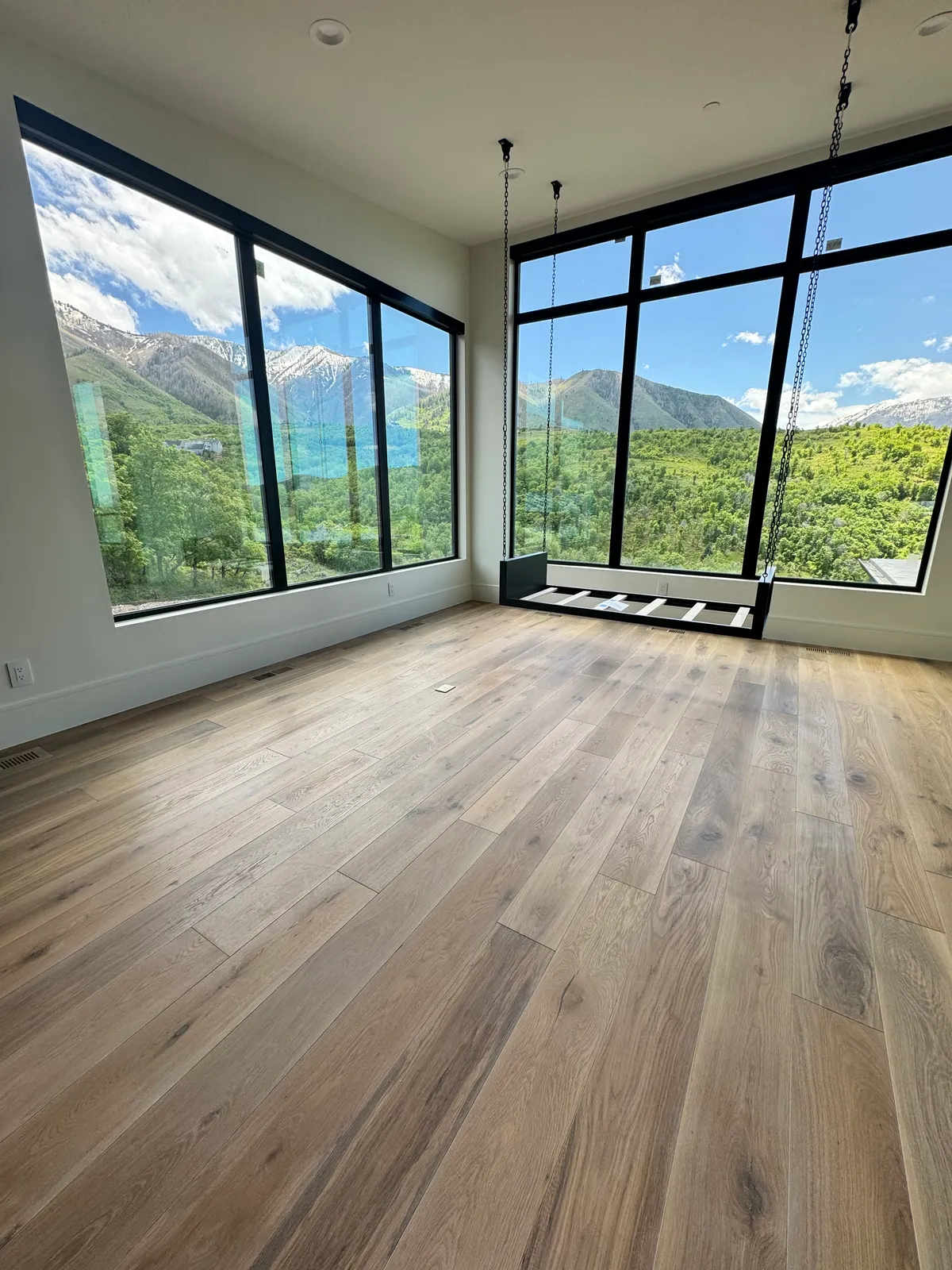
Best Flooring for Mountain Homes in Utah
Mountain homes in Utah are hard on floors.
They need to feel warm, elevated, and intentional, but they also have to handle snow, dry winter air, ski traffic, trail dust, dogs, guests, bigger windows, stronger light, and sometimes long periods where the home is not occupied full-time.
That mix changes the flooring decision.
The best floor for a valley home may not be the best floor for Park City, Heber, Midway, Kamas, Oakley, Eden, Huntsville, or a second home on the Wasatch Back. Mountain homes need flooring that looks premium without becoming fragile.
Quick Answer: Best Flooring for Utah Mountain Homes
For most Utah mountain homes, the best flooring plan is usually:
- Engineered hardwood in main living spaces where real wood warmth and value matter.
- Textured tile in ski entries, mudrooms, laundry rooms, bathrooms, and true wet zones.
- Waterproof laminate in family rooms, lower levels, guest areas, and dog-heavy spaces where scratch resistance matters.
- Quality LVP in some lower levels, rentals, utility spaces, or rooms where water tolerance is the priority.
- Refinished existing hardwood when the floor is structurally sound and fits the home.
The strongest projects rarely use one material everywhere. They use the right material in each zone, then coordinate color, plank scale, and transitions so the home still feels designed.
What Makes Mountain Homes Different
Mountain homes ask more from flooring than standard remodels.
The biggest factors are:
- dry winter air
- higher elevation
- snow, slush, and grit at entries
- ski and trail gear
- strong daylight through larger windows
- open great rooms
- dogs and guest traffic
- second-home or lock-and-leave use
- radiant heat or concrete conditions in some homes
- higher resale expectations in premium markets
Those pressures create two risks.
The floor can be too delicate for the way the house is used, or it can be too practical-looking for the value and finish level of the home.
Good mountain-home flooring avoids both.
Engineered Hardwood: Best for Main Living Spaces
Engineered hardwood is usually the best real-wood option for Utah mountain homes.
It gives you the warmth and material credibility of hardwood with better dimensional stability than solid wood. That matters in dry mountain conditions where winter heating and low humidity can cause wood movement.
Engineered hardwood belongs in:
- great rooms
- dining areas
- primary suites
- main-level halls
- stairs and landings
- rooms where the floor carries the design
What matters most:
- stable core construction
- meaningful wear-layer thickness
- matte or low-sheen finish
- natural or medium tones
- texture that hides real life
- plank width that fits the scale of the room
For Utah mountain homes, real wood is usually worth the spend where it changes how the home feels. It is not always worth forcing into every wet or high-abuse zone.
For the deeper hardwood framework, read hardwood flooring in Utah.
Solid Hardwood: Premium, but Higher Risk
Solid hardwood can be beautiful in a mountain home, but it is not automatically the better product.
The issue is movement. Solid wood reacts more to humidity swings than engineered hardwood. In dry, high-elevation conditions, that can mean seasonal gapping, cupping risk, or more maintenance discipline.
Solid hardwood is most realistic when:
- the home has stable main-level conditions
- there is no below-grade or concrete installation
- the owner manages indoor humidity
- long-term refinishing life matters
- seasonal movement is understood and accepted
For many mountain homes, engineered hardwood is the more practical premium choice.
Waterproof Laminate: Best for Active Family Zones
Waterproof laminate has become one of the strongest options for mountain homes that need durability without giving up a wood-look design.
It works well in:
- lower levels
- family rooms
- guest suites
- kids’ spaces
- dog-heavy rooms
- second homes with rotating visitors
- spaces where cleanup and scratch resistance matter
Quality matters. Cheap laminate can look wrong in a premium mountain home. Better waterproof laminate can look intentional and handle everyday abuse better than hardwood.
Use laminate where the room needs to be easier to live with, not where the home needs true real-wood character.
If you are comparing options, read hardwood vs. laminate in Utah.
LVP: Useful Where Water Comes First
LVP can make sense in mountain homes, but it should be chosen carefully.
It is strongest in:
- lower levels
- rentals or guest-heavy properties
- utility spaces
- some condos and townhomes
- rooms where water tolerance matters most
The downside is feel. Some LVP looks flat or plastic in homes with natural wood, stone, beams, big windows, and warmer mountain finishes. If the home is high-finish, the product needs enough texture, color variation, and plank realism to belong.
For a broader material comparison, read hardwood vs. LVP in Utah.
Tile: The Best Answer for Wet Entries
Tile is still the strongest flooring choice for true wet zones.
In mountain homes, that usually means:
- ski entries
- mudrooms
- laundry rooms
- bathrooms
- garage entries
- boot and gear drop zones
The key is texture. Slick glossy tile can be a poor fit when boots, dogs, and wet floors are part of the house. Textured or matte porcelain usually performs better.
The best projects use tile where water is unavoidable, then transition cleanly into wood, laminate, or LVP where the house needs warmth.
Best Flooring by Room
| Room or Zone | Best Starting Point | Why |
|---|---|---|
| Great room | Engineered hardwood | Warmth, value, and visual credibility |
| Dining area | Engineered hardwood | Premium feel in visible space |
| Mudroom | Textured tile | Water, grit, and boots |
| Lower level | Waterproof laminate or LVP | Durability and cleanup |
| Guest suite | Laminate, LVP, or engineered hardwood | Depends on finish level and traffic |
| Stairs | Engineered hardwood or coordinated stair system | Needs intentional transitions |
| Bathrooms | Tile or water-tolerant product | Moisture risk |
| Dog-heavy family room | Waterproof laminate | Scratch resistance and easy cleanup |
This is why mountain homes usually need a flooring plan, not just a product selection.
Full-Time Homes vs. Second Homes
Full-time homes and second homes have different flooring needs.
Full-time mountain homes
The floor has to handle daily wear: kids, dogs, groceries, snow, mud, furniture, and repeated traffic lanes. Durability and maintenance matter because the home is lived in every day.
Second homes
Second homes often need simpler maintenance. The floor may see bursts of heavy guest use, then sit unused. Materials that clean easily and do not require constant attention usually win in guest spaces and lower levels.
Rental or guest-heavy properties
If the property has rotating visitors, be honest about abuse. Beautiful floors still need to survive luggage, boots, spills, pets, and people who do not treat the home like the owner does.
Color and Finish Matter More in Mountain Light
Mountain homes often have strong natural light, larger windows, and bigger rooms.
That makes finish decisions more obvious:
- glossy floors show scratches faster
- dark floors show dust, hair, and paw marks
- very gray floors can feel cold against mountain finishes
- tiny samples are misleading in large rooms
- matte natural tones are usually easier to live with
For most Utah mountain homes, natural oak, warm neutrals, matte finishes, and some texture age better than dark, glossy, high-contrast floors.
Existing Hardwood: Refinish Before Replacing
If the home already has hardwood, inspect it before assuming replacement.
Refinishing can make sense when:
- the boards are structurally sound
- there is enough thickness left
- the layout still works
- the owner likes the character
- the issue is color, sheen, or surface wear
Replacement makes more sense when:
- there is major water damage
- the floor has been sanded too many times
- pet damage is deep
- the layout needs to change
- the species or width no longer fits the remodel
For that decision, read refinishing vs. replacing hardwood floors in Utah.
Common Mistakes in Utah Mountain Homes
The biggest mistakes are predictable:
- using solid hardwood where engineered hardwood would be safer
- putting wood too close to wet ski or mudroom traffic
- choosing cheap LVP or laminate in a premium main room
- using one material everywhere even when the home needs zones
- choosing dark glossy floors that show every mark
- ignoring stairs and transitions until late in the quote
- choosing from a small sample instead of seeing the floor in mountain light
Most mistakes come from starting with the product instead of the house.
Local Mountain Markets We Think About Differently
Park City
Finish level, resale expectations, HOA rules, ski traffic, and second-home use often drive the decision. Read the full Park City flooring guide.
Heber and Midway
Family living, newer construction, bigger rooms, and Wasatch Back climate make engineered hardwood and premium waterproof laminate strong starting points. Read Heber flooring.
Kamas, Oakley, and Peoa
These homes often need practical durability, mudroom planning, and warm finishes that fit mountain and rural-adjacent living.
Eden and Huntsville
Lake, mountain, and second-home patterns make entries, lower levels, and guest traffic especially important.
Our Practical Recommendation
For most Utah mountain homes, we would start with this plan:
- Use engineered hardwood in the main spaces that need warmth and value.
- Use tile in true wet-entry and mudroom zones.
- Use waterproof laminate or LVP in lower levels, guest spaces, and high-abuse rooms.
- Refinish existing hardwood if it is worth saving.
- Coordinate transitions so the house feels intentional instead of patched together.
That gives the home the right balance: premium where it matters, practical where life is harder on the floor.
FAQ: Flooring for Utah Mountain Homes
What flooring is best for mountain homes in Utah?
Engineered hardwood is usually best for main living spaces, tile is best for wet entries and mudrooms, and waterproof laminate or LVP is often best for lower levels, guest spaces, and high-traffic areas.
Is hardwood a good choice for a mountain home?
Yes, especially engineered hardwood. It gives you real wood warmth with better stability than solid hardwood in dry mountain conditions.
What flooring is best for ski homes?
Use tile or a truly durable waterproof material near ski entries and mudrooms. Use engineered hardwood in main living spaces where warmth and value matter.
Should second homes use hardwood or laminate?
Use engineered hardwood in premium visible spaces and waterproof laminate or LVP in guest-heavy, lower-level, or easier-maintenance rooms.
Does elevation affect hardwood flooring?
Yes. Higher elevation and dry winter air can increase seasonal movement. That is one reason engineered hardwood is often safer than solid hardwood in Utah mountain homes.
See the Right Floors in Your Mountain Home
Mountain-home flooring decisions get clearer when you see the options in the actual house.
We bring curated hardwood, laminate, LVP, tile-transition, and refinishing options into your home, compare them in your light, and build the quote line by line so the floor fits the house instead of a showroom display.
If you are ready to compare the right options, book your Free In-Home Floor Fit Consultation.