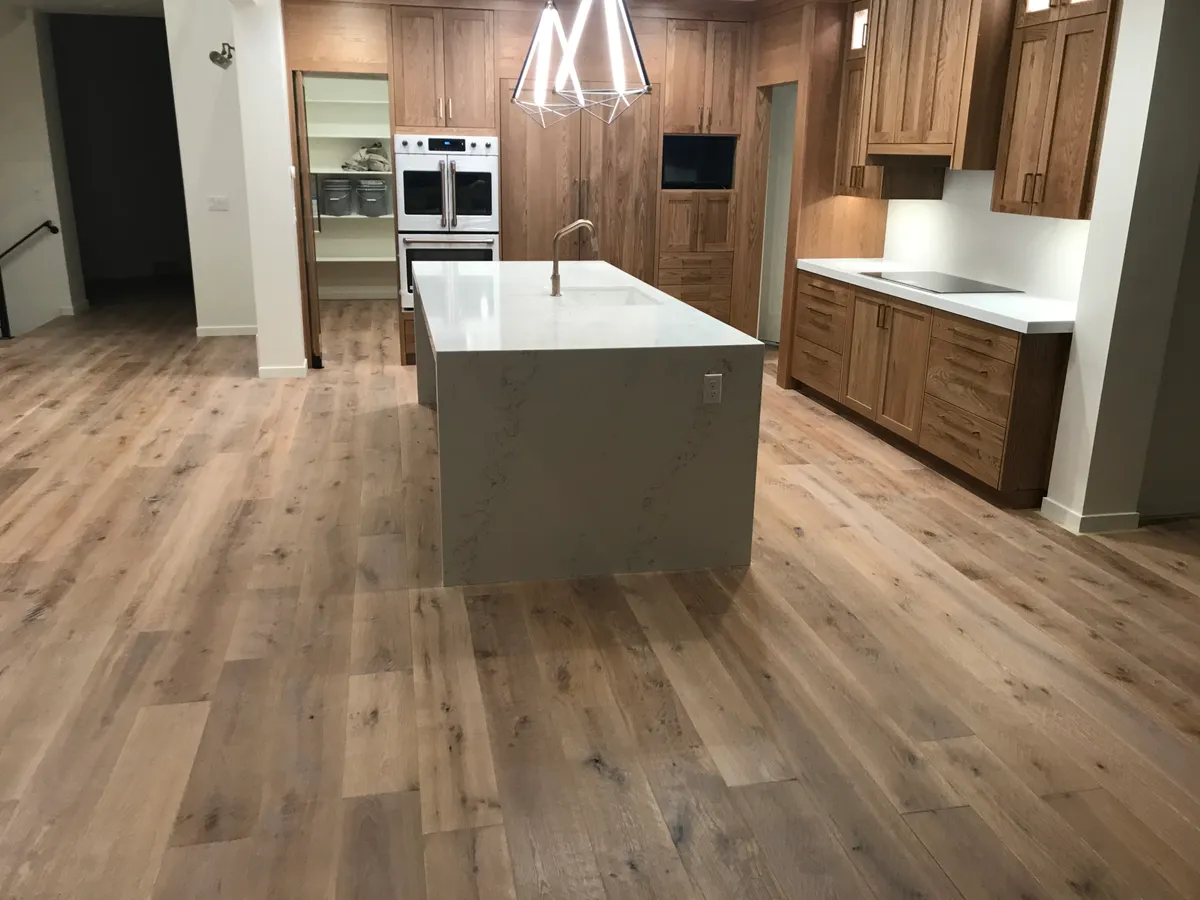
White oak flooring became popular in Utah because it solves the design problem a lot of homeowners are trying to solve: they want real hardwood that feels clean, warm, current, and high-end without turning the house orange, gray, or overly trendy.
It works in new construction. It works in remodels. It works in mountain homes. It works with white cabinets, black windows, stone fireplaces, warm wood accents, and the bright natural light common across the Wasatch Front.
That does not mean every white oak floor is automatically the right floor. Species, construction, width, finish, wear layer, installation method, and stain color all matter.
Why white oak is so popular in Utah
White oak has a calmer grain than red oak and a more neutral undertone. That is the main design reason homeowners ask for it.
In practical terms, white oak gives you:
- a cleaner modern hardwood look
- less pink and red undertone than red oak
- strong durability for active homes
- good resale appeal
- broad finish options from natural to warm brown
- a better fit for current Utah design palettes
It is not just a social media trend. It became popular because it fits the homes people are actually building and remodeling here.
White oak vs. red oak
The biggest difference is not just color. It is how the grain and undertone behave once the floor is installed across a full room.
White oak usually looks more neutral, more matte, and more controlled. Red oak usually has stronger grain and warmer pink, amber, or salmon undertones.
| Feature | White Oak | Red Oak |
|---|---|---|
| Undertone | Neutral, beige, olive, light brown | Pink, amber, warm red |
| Grain | Tighter and calmer | More open and pronounced |
| Janka hardness | About 1,360 | About 1,290 |
| Best design fit | Modern, transitional, mountain, warm-minimal | Traditional, classic, existing red oak homes |
| Stain behavior | Handles natural and light neutral tones well | Can fight pale white-oak looks |
Red oak is still a good hardwood. It just does not naturally create the same soft white-oak look homeowners are asking for right now.
Utah’s dry climate and seasonal movement
Hardwood moves with humidity. Utah homes are dry, especially during winter when furnaces run and indoor humidity drops.
That means proper product selection and installation matter more than the species name alone.
White oak has good stability for hardwood, but it still needs:
- proper acclimation before installation
- moisture readings on the subfloor and flooring
- manufacturer-approved installation method
- realistic humidity expectations
- correct expansion space
Seasonal gaps can happen with real hardwood in Utah. A good installer works to reduce that risk, but no honest hardwood contractor should pretend wood never moves.
Solid white oak vs. engineered white oak
Both can be good choices. The right answer depends on where the floor is going and how the home is built.
Solid white oak
Solid white oak is a single piece of hardwood, usually 3/4 inch thick. It can be refinished multiple times over its life and is a strong choice for plywood subfloors on main levels.
It makes the most sense when:
- the home has a suitable wood subfloor
- long-term refinishing matters
- the homeowner wants traditional hardwood construction
- moisture and humidity are well controlled
Engineered white oak
Engineered white oak has a real white oak surface over a stable core. Quality engineered hardwood can be an excellent fit for Utah because it handles dimensional movement better than solid in many situations.
It often makes sense for:
- wider planks
- concrete slabs
- basements where hardwood is appropriate
- radiant heat systems with approved products
- homeowners who want real wood with more stability
The key is wear layer thickness. A thin veneer product may look good but offer limited long-term refinishing options. A stronger engineered floor with a meaningful wear layer gives you more flexibility.
For a deeper comparison, read engineered vs. solid hardwood in Utah.
Best white oak colors and finishes
White oak looks best when the finish works with the wood instead of fighting it.
The most requested white oak looks right now are:
- Natural matte: light, clean, and timeless.
- Light neutral brown: slightly warmer than natural, still modern.
- Warm medium brown: more forgiving for family traffic and pets.
- Soft greige: works in the right modern home but needs careful testing.
- Reactive or oil finishes: premium look, more nuanced color, usually more product-specific.
Very gray finishes are riskier than they used to be. Strong gray floors can date faster and can make a home feel colder than intended. A softer natural or warm neutral tone usually ages better.
If color is the main decision, use our guide to hardwood stain colors in Utah.
White oak for dogs and kids
White oak is durable enough for real family use, but finish and color matter as much as species.
For dogs, kids, and heavy traffic, avoid assuming the hardest-looking floor is automatically the easiest to live with. Very dark floors show scratches and hair. Very pale floors can show grime in busy areas. Matte or low-sheen finishes usually hide wear better than glossy finishes.
If pets are a major part of the decision, compare this with our guide to the best hardwood for dogs in Utah.
White oak in kitchens, stairs, and main floors
White oak is a strong choice for main floors because it creates one continuous look across the spaces people care about most: entry, kitchen, dining, living room, and stairs.
It can work well in kitchens as long as the homeowner understands hardwood is water-resistant, not waterproof. Spills should be wiped up, sink areas need common sense, and dishwashers or refrigerators should be monitored like they would be with any wood floor.
For stairs, white oak is often one of the best visual choices because it can coordinate treads, landings, railings, and adjacent main-floor hardwood.
What white oak costs in Utah
Installed white oak pricing depends on product quality, construction, width, floor prep, stairs, demo, transitions, and installation method.
As a practical planning range, many white oak projects land around:
- Engineered white oak installed: often about $11 to $18+ per square foot
- Solid white oak installed: often about $12 to $20+ per square foot
- Premium wide-plank products: can go higher depending on brand, wear layer, grade, and finish
Those ranges are planning numbers, not a quote. Site conditions change the real price fast.
For a more detailed breakdown, read hardwood installation cost in Utah.
White oak vs. LVP
Luxury vinyl plank is useful in the right setting. It is waterproof, predictable, and often lower cost. For rentals, basements with water risk, laundry rooms, or budget-driven projects, LVP may be the better business decision.
White oak is different. It is real wood. It feels warmer underfoot, can improve resale perception, and can age in a way synthetic products do not.
The decision is not “which product is universally better.” It is where the floor is going, how long you plan to stay, what the home is worth, and what kind of finish you want the space to have.
Questions to ask before choosing white oak
Before approving a white oak product, ask:
- Is this solid or engineered?
- What is the wear layer thickness?
- Can it be refinished later?
- What installation method does the manufacturer approve?
- Is the product approved for the subfloor?
- How wide are the planks?
- What finish sheen is it?
- How does the sample look in my actual light?
- What happens at stairs and transitions?
Those answers matter more than the product photo.
The best next step
White oak is one of the best hardwood options for many Utah homes, but the final decision should happen in the actual space. A sample that looks perfect online can shift dramatically next to your cabinets, paint, windows, and furniture.
During a Free In-Home Floor Fit Consultation, we bring curated samples, compare them in your light, talk through installation and budget, and help you choose a floor that fits the house instead of just the trend.
Book your Free In-Home Floor Fit Consultation
FAQ
Is white oak flooring good for Utah homes?
Yes. White oak is a strong fit for many Utah homes because it has a neutral look, good durability, and broad design flexibility. It still needs proper installation and humidity expectations because real hardwood moves with seasonal conditions.
Is engineered white oak better than solid white oak?
Not always. Engineered white oak is often better for wide planks, concrete, and stability. Solid white oak is better when long-term refinishing is the priority and the subfloor is appropriate.
Does white oak scratch easily?
White oak is a durable hardwood, but it is not scratch-proof. Finish sheen, stain color, pets, furniture pads, and maintenance habits all affect how visible scratches become.
What is the most timeless white oak color?
Natural matte, light neutral brown, and warm medium brown are usually the safest long-term options. Strong gray or very dark finishes can work, but they are more specific and less forgiving.
Can existing red oak be refinished to look like white oak?
Only partially. Red oak has warmer undertones that cannot be completely removed with stain. Refinishing can improve the color, but it usually cannot make red oak behave exactly like white oak.