The Short Answer
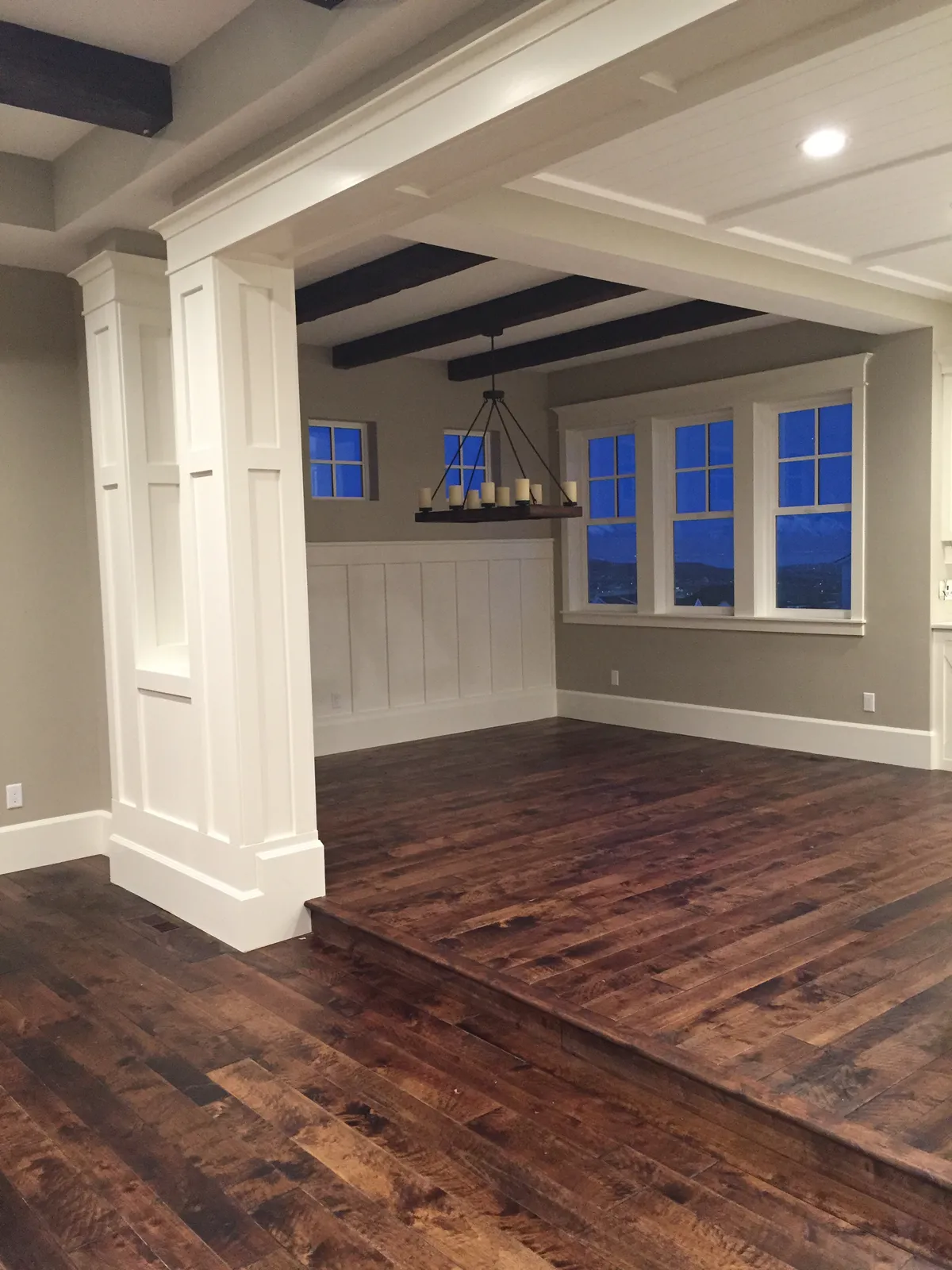
If you want a floor that performs well across your whole home at a price that doesn’t require financing, laminate is worth taking seriously. If you’re doing a main-floor living room or dining room and you care about long-term investment value, hardwood is hard to beat.
Most Utah homes we work in end up with a combination of both. Here’s how to figure out which goes where.
What Hardwood Actually Is
Hardwood flooring comes in two forms: solid and engineered. This distinction matters a lot in Utah, so it’s worth understanding before you choose.
Solid hardwood is exactly what it sounds like: a single plank of milled wood, typically 3/4” thick. It can be sanded and refinished multiple times over its lifetime, which is why a well-maintained hardwood floor can last 50 years or more. The tradeoff is that solid wood moves with humidity. It expands when the air is wet and contracts when it’s dry.
Engineered hardwood has a real wood veneer on top (the same species, the same grain, the same look) bonded over a layered core, usually plywood or HDF. That layered construction makes it significantly more dimensionally stable. It handles humidity swings better than solid, and it can still be refinished once or twice depending on the veneer thickness.
The most popular species we see in Salt Lake Valley homes right now are white oak, hickory, and walnut. White oak has become the go-to for Mountain Modern interiors: neutral, tight-grained, works with almost everything. Wide planks (5” and up) are the dominant trend, though narrower planks are a smart move in rooms where stability is a concern.
What Laminate Actually Is
Modern laminate is not what it was in the 1990s. If your mental image is a thin, hollow-sounding product that peels at the edges, update that picture.
Laminate has an HDF core (high-density fiberboard) that gives it a dense, solid feel underfoot. Above that core sits a high-resolution photographic layer and a hard, clear wear layer rated on the AC scale. AC4 is the commercial-rated standard for high-traffic residential use.
The laminate we carry is GemCore. Its relevant specs:
- 12mm thickness, which is noticeably thicker than most floating floors and contributes meaningfully to underfoot feel
- AC4 commercial surface rating for durability
- True Wood Touch EIR texture (the texture is aligned with the printed grain pattern, not applied generically)
- Ultra-matte finish that resists glare and hides dust better than glossy options
- 3-part waterproof system with a swell ratio under 6% (significantly better than standard laminate)
- Steam mop safe
- No transition moldings needed for runs up to 65 feet
- Lifetime residential warranty and a dedicated pet warranty
- Installed pricing: $6.50–$10/sq ft
To be accurate: GemCore is not 100% waterproof in the way a fully synthetic product is. It’s a highly water-resistant laminate with a very low swell ratio. For rooms with standing water risk (bathrooms, laundry rooms), the conversation is different.
Want to See Both in Your Home Before You Decide?
We bring samples of hardwood and laminate directly to your door so you can compare them in your actual lighting, next to your actual walls and cabinets. Book a free consultation.
Side-by-Side Comparison
| Hardwood | Laminate (GemCore) | |
|---|---|---|
| Material | Real wood (solid or engineered veneer) | HDF core with photographic layer and wear surface |
| Waterproof | No; avoid kitchens, baths, basements | 3-part waterproof system; swell ratio under 6%; steam mop safe |
| Cost, installed | $11–$18/sq ft | $6.50–$10/sq ft |
| Refinishable | Yes (solid: 3-4 times; engineered: 1-2 times) | No |
| Lifespan | 50+ years (solid); 25-30 years (engineered) with care | 20-25 years |
| Thickness | 3/4” (solid); 3/8–1/2” (engineered) | 12mm |
| Underfoot feel | Dense, solid, unmistakably real wood | Dense and firm; 12mm gives it a real-wood quality |
| Resale value | High; buyers notice and respond to real hardwood | Good; modern laminate reads well to buyers |
| Stability in dry climates | Lower (solid) / Higher (engineered) | Strong; swell ratio under 6% |
| Transitions | Required between rooms and flooring types | Not needed for runs up to 65 feet |
| Warranty | Varies by manufacturer | Lifetime residential + pet warranty |
| Best rooms | Living rooms, dining rooms, bedrooms | Living rooms, bedrooms, offices, open-plan spaces |
| Pet and kid friendly | Moderate; surface can scratch | Very good; AC4 rating handles heavy use |
Utah’s Climate Changes the Math
This is the part most flooring guides skip, and it’s the part that matters most if you live on the Wasatch Front.
Salt Lake City sits at 4,226 feet above sea level. Indoor humidity in winter regularly drops below 20%, sometimes below 10% in very cold snaps. That’s close to desert conditions inside your home.
The impact on hardwood: Wood contracts when it loses moisture. In a dry Utah winter, a solid hardwood floor will gap between planks. That’s not a defect; it’s physics. Come spring when humidity rises slightly, those gaps close back up. Most homeowners adjust to the seasonal movement over time, but it can be disconcerting if you weren’t told to expect it.
Three ways to manage it:
- Choose engineered over solid. The layered core resists humidity swings significantly better than solid wood. For most Utah homes, engineered hardwood is the smarter pick: same look, better performance.
- Mind your plank width. Wider planks have more surface area to expand and contract. In rooms where stability is a concern, narrower planks (3-4”) are the conservative choice.
- Acclimate properly. A good installer lets hardwood sit in your home for 48-72 hours before installation, adjusting to your specific humidity conditions.
The impact on laminate: GemCore’s swell ratio under 6% means it moves less with Utah’s humidity swings than standard laminate or solid hardwood. In dry winter conditions, it holds together better at the seams. In humid summer conditions, it has less expansion pressure at the perimeter gaps. This is a real performance advantage in our climate.
The basement question: Utah basements sit below grade on concrete slabs that absorb and release moisture seasonally. Hardwood below grade in Utah is a risk we won’t recommend. Laminate in a well-conditioned basement can work, but it requires a proper moisture barrier and verification that the space is genuinely dry. This is a case-by-case conversation.
Room-by-Room Recommendations
Living Room and Dining Room
Hardwood is the investment choice. Laminate is the smart budget alternative.
These are the rooms buyers notice at resale. If you have the budget for engineered white oak or hickory in a wide-plank format, use it here. If budget is the driving factor, GemCore laminate in the living and dining areas is not a compromise you’ll regret. The AC4 rating, 12mm thickness, and EIR texture produce a product that reads as high quality in person.
Kitchen
Laminate, with care; or discuss other options with us.
GemCore’s 3-part waterproof system makes it significantly more kitchen-friendly than traditional laminate. Prompt cleanup of spills and proper installation are the conditions. Hardwood in a kitchen requires more vigilance near the sink and dishwasher. Both can work; just know their respective limits.
Basement
Not hardwood. Laminate requires a conversation.
Utah basements sit on concrete slabs with seasonal vapor transmission. Hardwood in a Utah basement is a risk not worth taking. GemCore can work in a properly conditioned basement with a moisture barrier, but the specific conditions of your space matter. We assess this during the consultation before making a recommendation.
Bedrooms
Either works well. Bedrooms see lighter traffic, lower moisture, and no food. Hardwood adds warmth and long-term refinishability. GemCore is an excellent choice if you’re running a consistent floor through the rest of the home and bedrooms are part of that run.
Bathrooms
Neither, by default. Tile is the right call for full bathrooms. If you’re exploring alternatives for a powder room or a bathroom with good ventilation, that’s a different conversation.
Mudrooms and Laundry Rooms
Neither is ideal. High moisture, boots, and wet gear from a Utah ski weekend make these rooms hard on any product. Tile is the right call.
Pros and Cons
Hardwood
Pros
- Real wood: the look and feel are unmatched
- Refinishable: can be sanded and restained multiple times over its life
- Long lifespan when maintained; 50 years is realistic with solid hardwood
- Strong resale value: buyers respond to hardwood
- Develops patina and character over time
Cons
- Higher upfront cost: $11–$18/sq ft installed
- Not waterproof; not suitable for kitchens, baths, or below grade in Utah
- Requires careful management in Utah’s dry climate (engineered mitigates this significantly)
- Seasonal gapping is normal with solid wood
- Installation requires acclimation period and careful subfloor prep
Laminate (GemCore)
Pros
- Significantly lower cost: $6.50–$10/sq ft installed
- 12mm thickness gives it a dense, wood-like feel underfoot
- AC4 commercial surface rating handles heavy residential use
- Swell ratio under 6% outperforms standard laminate in Utah’s humidity swings
- No transition moldings needed for runs up to 65 feet
- Lifetime residential warranty and pet warranty
- Steam mop safe
- EIR texture and ultra-matte finish produce a convincing, high-quality look
Cons
- Not refinishable; when the wear surface is gone, the floor is done
- Shorter lifespan than hardwood: 20-25 years vs. 50+ for solid
- Not 100% waterproof; standing water and flooding are still risks
- Resale perception is a step below real hardwood for high-end buyers
- Individual plank replacement possible but depends on matching product availability years later
Our Recommendation
For most Utah homes, the right answer is a combination.
Run engineered hardwood on your main living floor: living room, dining room, and wherever you want that warm, investment-grade look. Run GemCore laminate in bedrooms, home offices, and any large open-plan space where the continuous run capability (no transitions up to 65 feet) is a practical advantage. Use tile or a fully waterproof option anywhere moisture is a real variable.
The biggest mistake we see is defaulting to a single product everywhere to simplify the decision, then wishing the living room had hardwood when it comes time to sell. The second mistake is putting hardwood somewhere it doesn’t belong and dealing with moisture damage a few winters later.
The one thing that makes this decision genuinely easy: seeing both options in your home, in your lighting, against your walls. A white oak sample looks different in a Sugar House craftsman than it does in a new build in Daybreak. That’s exactly why we bring the samples to you instead of asking you to make a decision under fluorescent showroom lights.
Book a Free Consultation
We bring curated samples of hardwood and laminate directly to your door. No trip to a showroom, no second-guessing under bad lighting. You see exactly how each option looks in your space, we measure your rooms, and you leave with a firm quote before we walk out the door.
No pressure. No obligation.