Cedar Hills at a Glance
Cedar Hills is one of those Utah County cities that people outside the area haven’t heard of, and residents like it that way. With just under 10,000 people tucked against the base of American Fork Canyon, it’s a tight-knit community with a residential character that bigger neighbors can’t match.
The housing stock is predominantly single-family homes built between the mid-1990s and early 2010s. There’s very little new construction: the city is largely built out. That makes Cedar Hills a renovation market. Homeowners aren’t upgrading builder-grade carpet in a new build. They’re replacing floors that have been there for fifteen or twenty years.
Cedar Hills sits adjacent to Alpine and Highland: check our Alpine & Highland flooring guide for those communities, and we serve all three. The housing profiles are similar, established neighborhoods, family-oriented, and homes that were built well but are ready for updated finishes.
Best Flooring Options for Cedar Hills Homes
Laminate: Built for Canyon-Adjacent Living
Waterproof laminate is our top recommendation for most Cedar Hills homes, and the canyon proximity is a big reason why.
Living at the mouth of American Fork Canyon means more temperature variation than cities out in the valley. Canyon winds bring cooler air in the evenings, mornings run significantly colder than afternoons, and winter swings are more pronounced. Laminate is dimensionally stable across all of it. No gapping, no buckling, no shifting.
It’s also the practical choice for families who use the canyon. Hiking, mountain biking, fishing. You’re tracking dirt, gravel, and moisture through your front door regularly. Laminate handles all of it.
For whole-home installations in homes that are 15-20 years old, a rigid-core SPC product with a 20-mil wear layer transforms the space, especially when you’re replacing carpet that’s been there since the original build.
Engineered Hardwood: The Premium Play
Many Cedar Hills homeowners are renovating not because the home needs rescuing, but because they want to elevate it. Engineered hardwood on the main floor is a strong move for that scenario.
A wide-plank white oak or European oak in a natural, matte finish gives a Cedar Hills home a refined look. The engineered construction handles Utah’s dry climate and the additional temperature variability from the canyon, solid hardwood would be risky here.
Run hardwood through the great room, dining area, and entry, then laminate in the kitchen, bathrooms, and basement. If you’re weighing these two options, our hardwood vs. Laminate comparison breaks down the trade-offs. That’s the highest-value combination for homes in this price range.
Cedar Hills-Specific Considerations
Canyon wind temperature swings. Cedar Hills gets direct airflow from American Fork Canyon, creating more dramatic temperature shifts than Orem or Pleasant Grove. Products with poor dimensional stability (solid hardwood) are higher risk. The National Wood Flooring Association recommends engineered construction in any environment with wide humidity swings. Engineered hardwood and laminate both handle these fluctuations without movement.
Renovation-ready subfloors. Most homes here are 15-25 years old. Carpet removal often reveals stained tack strip holes and occasional subfloor patches. Completely normal for an established home. We account for prep work in our estimates.
Mature landscaping affects basement moisture. Established trees, gardens, and irrigation can affect soil moisture around foundations. If you’re flooring a basement, moisture testing is especially important. We’ve seen Cedar Hills basements that feel dry but test higher for moisture vapor than expected. We always test before installing.
Quality carpet still works upstairs. In Cedar Hills bedrooms, especially upstairs, a quality 40-oz nylon or triexta carpet with a good pad still makes sense. Bedrooms are low-traffic, comfort matters, and sound dampening between floors is a real benefit.
What Cedar Hills Homeowners Are Choosing
The typical project here is a main-floor renovation, replacing 15-to-20-year-old carpet and outdated tile with either wall-to-wall laminate or an engineered hardwood and laminate combination.
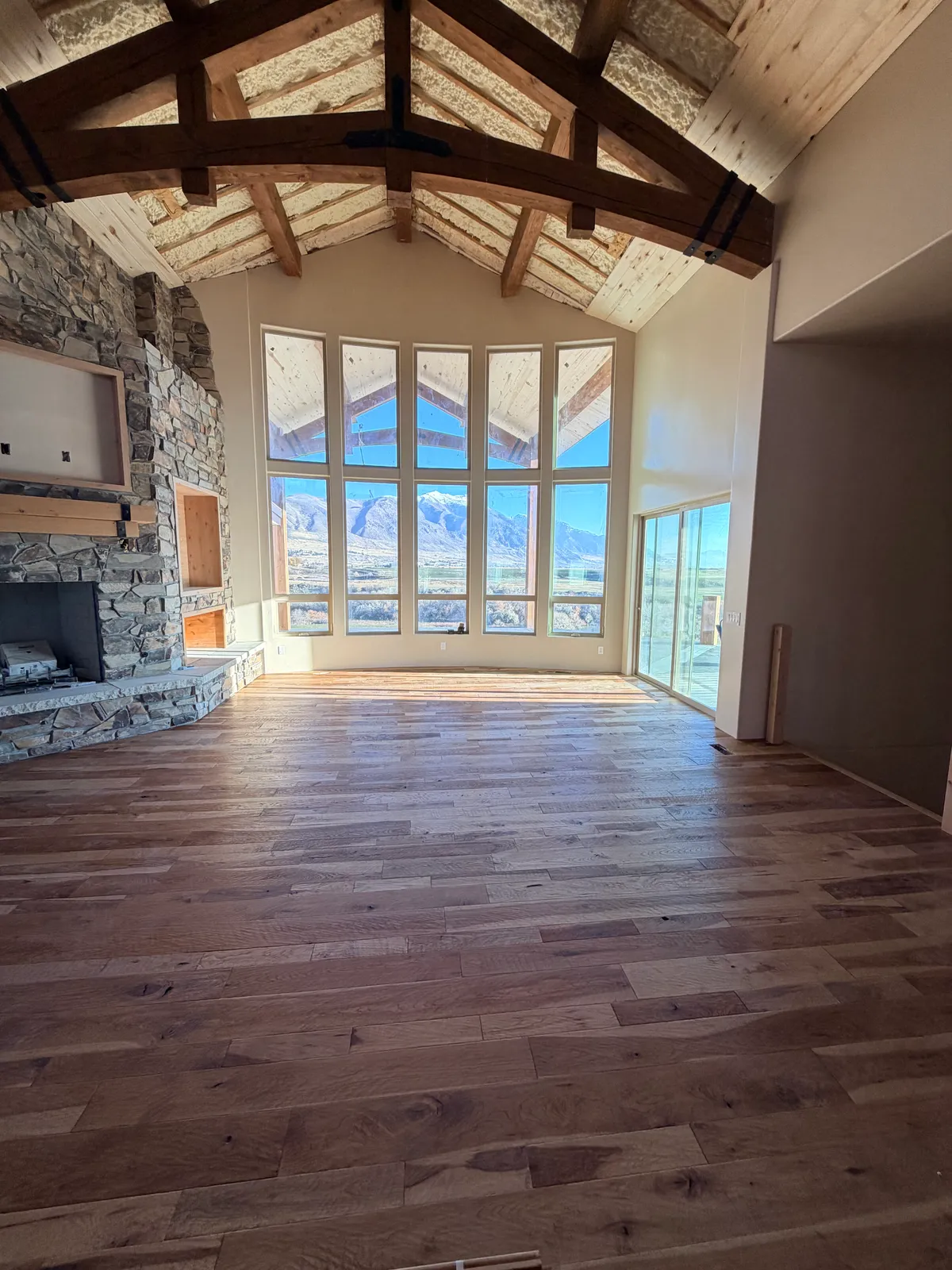
Color preferences lean toward natural wood tones. Light-to-medium oak, warm walnut undertones, and soft hickory are the most popular. These work well with the earth tones and natural surroundings of canyon-adjacent living. Ultra-modern gray finishes tend to feel out of place, homeowners gravitate toward warmer, organic looks.
Basement projects are common too. After 15-plus years, original basement carpet is past its useful life. Laminate gives the basement a cleaner feel and eliminates the mustiness old below-grade carpet develops. The EPA’s guidance on indoor air quality highlights old carpet as a significant allergen trap, especially in below-grade spaces.
The flooring cost guide breaks down installed pricing if you’re comparing options.
See Flooring in Your Cedar Hills Home
The light here is unique. Canyon-adjacent homes get strong morning light and softer, cooler light in the evenings as the canyon shades the valley. That affects how every flooring color reads in your space, a showroom sample can look completely different at home.
We bring curated samples directly to your Cedar Hills, Alpine, or Highland home. We measure, talk through options, and give you a firm quote in about 45 minutes.
Book a free in-home consultation →