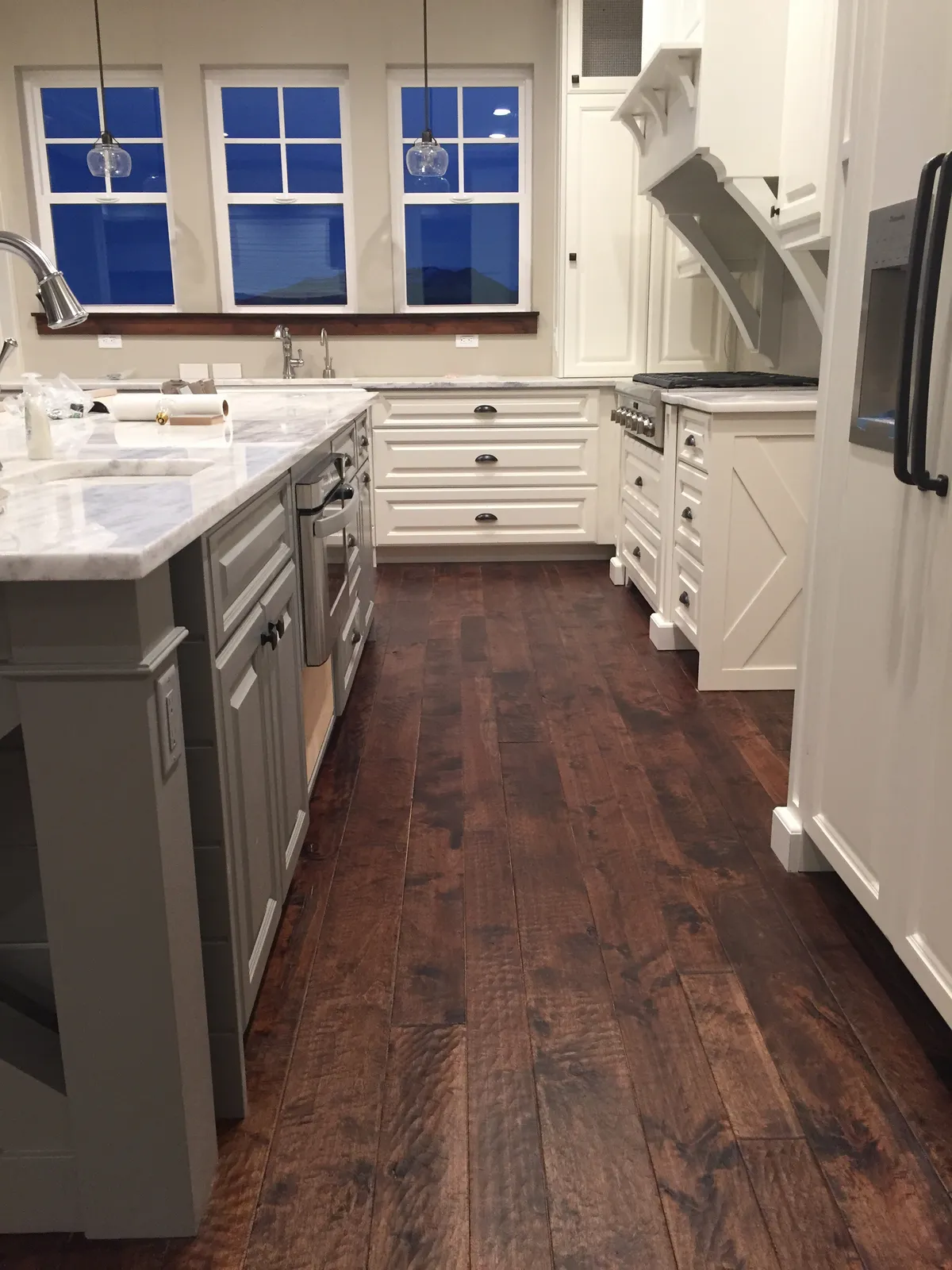
Best Flooring for Your Kitchen
Your kitchen floor has the hardest job in the house. It gets splashed, dripped on, walked across a hundred times a day, and occasionally hit with a cast iron pan dropped from counter height. Whatever you put down there needs to handle all of it without looking beaten up in two years.
But the kitchen isn’t just a utility room anymore. In most Utah homes (especially across the Salt Lake City metro) the kitchen is open to the living room, the dining area, and sometimes the entry. That means your kitchen floor needs to look great AND perform under pressure.
Here’s what actually works, what’s risky, and what to skip.
What Your Kitchen Floor Has to Survive
Before we talk materials, let’s be real about what happens in a kitchen:
- Water. Not just spills, think splashes from the sink, drips from the dishwasher, ice cubes that slide under the fridge and melt, kids with leaky cups. Water is constant.
- Drops and impacts. Cans, bottles, ceramic mugs, that one heavy cutting board. If it can fall, it will fall.
- Heavy foot traffic. The kitchen is the most-walked room in most homes. You’re in there multiple times a day.
- Staining agents. Red wine, coffee, cooking oil, tomato sauce. Your floor will meet all of them.
- Temperature swings. The oven at 425 degrees, the freezer door opening and closing, the back door letting in January air. The floor near your range lives in a different climate than the floor by your pantry.
Any flooring you choose needs to handle all five of these, every day, for years.
Waterproof Laminate: The Smart Default for Kitchens
Waterproof laminate with a 12mm fiber composite core is the best kitchen flooring for most homeowners. Full stop.
Here’s why:
- 100% waterproof. Not water-resistant, waterproof. A dishwasher leak that sits overnight won’t damage GemCore laminate. The water stays on the surface and between the seams, and the core material doesn’t absorb moisture. GemCore’s 3-part waterproof system is rated for exactly this kind of sustained exposure.
- AC4 rated. GemCore’s commercial-grade AC4 rating means it handles the heavy daily foot traffic a kitchen sees without wearing through.
- Comfortable underfoot. Compared to tile, waterproof laminate with an attached pad is noticeably warmer and softer. If you spend an hour cooking dinner, your feet and back notice the difference.
- Steam mop safe. Clean it how you’d actually clean a kitchen floor. No special protocols.
- Looks great. GemCore’s True Wood Touch EIR texture and ultra-matte finish come in wood-looks that are remarkably convincing. Oak, walnut, hickory, herringbone patterns. You have options.
What to look for in kitchen waterproof laminate:
- 12mm composite core: denser core means better feel underfoot and better impact absorption
- AC4 rating minimum: that’s the commercial threshold and the right spec for a high-traffic kitchen
- True 3-part waterproof system: not just a surface coating
- EIR texture: texture matched to the printed grain so the floor feels as real as it looks
Installed cost: $6.50–$10 per square foot in the Salt Lake City area.
For a comparison with hardwood, see our hardwood vs. Laminate guide.
Tile: The Bulletproof Alternative
Porcelain or ceramic tile is the classic kitchen floor, and it still makes a strong case.
What tile does best:
- Nothing damages it. Drop a cast iron skillet on porcelain tile and the tile wins. Spill red wine and walk away for an hour. No stain. Tile is the most durable kitchen flooring material, period.
- Completely waterproof: tile itself and properly grouted joints keep water out
- Heat-resistant: perfect near ranges and ovens
- Incredible variety: wood-look planks, large-format slabs, classic subway, encaustic patterns. Tile design has exploded in the last few years.
The downsides:
- Hard and cold underfoot. If you cook a lot, standing on tile for an hour is tough on your joints. Anti-fatigue mats help, but they cover up the floor you just paid for.
- Grout maintenance. Grout lines stain and can crack over time. Sealing helps, but it’s ongoing maintenance. Larger tiles mean fewer grout lines, which helps.
- Breakables break harder. Drop a wine glass on waterproof laminate and you might save it. Drop it on tile and you won’t.
- Higher installation cost. Tile installation is more labor-intensive than laminate. Budget more for install.
Installed cost: $8-15 per square foot depending on tile quality and pattern complexity.
Tile makes the most sense if durability is your top priority and you don’t mind the hardness underfoot. It’s particularly good for Utah homes with radiant floor heating, tile conducts heat beautifully.
Engineered Hardwood: Yes, It Can Work
A lot of people assume wood in the kitchen is a bad idea. That’s not quite right. Solid hardwood in the kitchen is risky. Engineered hardwood can work, with some awareness.
Why it works:
- The cross-grain construction handles Utah’s humidity swings better than solid wood
- It gives you a seamless flow from kitchen to living room in open floor plans (this is the biggest reason people choose it)
- Modern finishes with aluminum oxide topcoats are surprisingly water-resistant for normal kitchen use
The caveats:
- You need to wipe up spills promptly. Engineered hardwood handles splashes fine, but standing water over time can still damage the wear layer and seep between planks.
- It’s not the right choice if you have a history of dishwasher leaks or frequently leave wet items on the floor.
- Dropped heavy objects can dent wood more easily than waterproof laminate or tile.
When engineered hardwood makes sense in the kitchen: You have an open floor plan, you want real wood flowing from the living room through the kitchen, and you’re the type of person who wipes up spills when they happen. A lot of the newer homes in Daybreak, South Jordan, and Vineyard are built this way, and the hardwood holds up well when it’s cared for.
Installed cost: $8-14 per square foot.
For a full comparison of hardwood and waterproof laminate, check out our hardwood vs. Laminate guide for Utah homes.
What About Standard Laminate in the Kitchen?
Short answer: skip it. Standard laminate has an HDF core that absorbs water and swells. One spill that reaches a seam, one slow leak under the dishwasher, and you’re looking at warped planks that can’t be fixed, only replaced. Waterproof laminate (like GemCore) is a completely different product. It uses a composite core with a 3-part waterproof system and is designed for exactly this kind of exposure. For kitchens, waterproof laminate is the right call. Standard laminate is not.
The Open Floor Plan Problem (And How to Solve It)
Here’s the real-world challenge most Utah homeowners face: the kitchen isn’t a separate room.
In most Salt Lake City metro homes built in the last 20 years. From the subdivisions in Lehi and Saratoga Springs to the renovated bungalows in Sugar House. The kitchen opens directly into the living room and dining area. There’s no doorway. There’s no transition point. It’s one continuous space.
That means your kitchen flooring needs to flow seamlessly into the rest of your main floor. You have three ways to handle this:
Option 1: One material everywhere. Run waterproof laminate or engineered hardwood from the front door through the kitchen, living room, and dining area. This is the cleanest look and the simplest install. If you go waterproof laminate, you get waterproof protection everywhere. If you go engineered hardwood, you get the warmth of real wood everywhere. Just be mindful of spills in the kitchen zone.
Option 2: Transition at a natural break. If there’s a hallway, an island edge, or a slight change in ceiling height between the kitchen and living area, you can use a transition strip to change materials. This works if you want tile in the kitchen and hardwood in the living room, for example.
Option 3: Same look, different material. Some waterproof laminate and engineered hardwood lines come in matching colorways. You can run the hardwood in the living room and a visually matching waterproof laminate in the kitchen. It takes careful selection, but when done right, the visual is seamless while each room gets the best material for its demands.
We help homeowners navigate this all the time. Bringing samples into your actual kitchen and living room (and seeing them side by side at the transition point) makes this decision much easier than trying to match swatches under store lighting.
My Kitchen Floor Recommendation
For most Utah kitchens: waterproof laminate with a 12mm composite core and AC4 rating. It handles everything a kitchen throws at it, it’s comfortable underfoot, it looks great, and it flows well into open living spaces. GemCore’s 3-part waterproof system and steam mop compatibility make it a particularly strong fit for kitchen use.
If you have your heart set on real wood and an open floor plan, engineered hardwood is a reasonable choice. Just commit to wiping up spills and consider waterproof laminate in front of the sink and dishwasher area if you want extra insurance.
Tile is the right call if you prioritize bulletproof durability above all else, especially if you have radiant heat.
For the full picture on what flooring costs in our area, check the 2026 Salt Lake City flooring cost guide. And for a broader look at what works best across every room in a Utah home, start with our best flooring for Utah’s climate guide.
Want to See Kitchen Flooring Options in Your Actual Kitchen?
We’ll bring samples to your home so you can see how they look with your cabinets, your countertops, and your lighting. Not a showroom’s. No guessing, no pressure.